What science says about the ingredients in OXYBEET®
The ingredients in OXYBEET® were chosen for a reason. Here you can explore studies on beetroot, L-citrulline and vitamin C: what they found, the doses used and where to read the original studies.
All figures checked against the original sources. Reviewed in October 2026.
1998Nobel Prize for the discovery of NO
18peer-reviewed studies on this page
3ingredients that work together
4500 mgof L-citrulline per scoop
The basics
Nitric oxide (NO) causes blood vessels to relax
Nitric oxide (NO) is a gas your body produces naturally. Cells in the inner lining of your blood vessels release it, signalling the vessel walls to relax. The vessels widen, allowing blood to flow more freely.1
This signal gets weaker with age
Illustration based on Celermajer et al., 1994.
In a study of 238 healthy people, men's blood vessels maintained their ability to widen until around age 40, after which it declined each year. In women, it began to decline around age 50.2
Italian researchers showed that as we age, the availability of NO in blood vessels decreases and oxidative stress increases.3
1998 Nobel Prize
Three scientists discovered that NO acts as a signal to blood vessels
Robert F. Furchgott, Louis J. Ignarro and Ferid Murad received the Nobel Prize for their discoveries about the role of nitric oxide (NO) as a signalling molecule in the cardiovascular system. Until then, no one knew that a gas could carry a signal from one cell to another.1
Nobel Prize in Physiology or Medicine
Robert F. FurchgottSUNY, New YorkLouis J. IgnarroUCLA, Los AngelesFerid MuradUniversity of Texas, Houston
The scientists are not associated with OXYBEET®. The prize was awarded for the discovery of NO, not for any product. Photos: Jzubrovich (CC BY 3.0), Carlos Barretta (CC BY 2.0), Jeff Dahl (CC BY-SA 4.0), Wikimedia Commons.
How it works
A triple-action formula in one scoop
Beetroot and L-citrulline each help your body make NO in their own way, and vitamin C helps NO form and protects it.
Ingredient 1
Beetroot
Nitrates→Nitrites→NO
Beetroot contains natural nitrates. Bacteria on your tongue turn them into nitrites, which your body then uses to produce NO. That’s why it starts in the mouth.4
Ingredient 2
L-citrulline
L-citrulline→L-arginine→NO
L-citrulline is well absorbed, and your body converts it into L-arginine. Cells in your blood vessels use L-arginine to produce NO. When you take L-arginine, your body breaks down much of it in the gut, so L-citrulline raises blood levels of L-arginine more effectively.11
Ingredient 3
Vitamin C
Vitamin C→NO
In a cell study, vitamin C protected a substance from oxidation. Blood vessel cells need this substance to produce NO properly.19
Ingredient 1
Beetroot and nitrates
Beetroot nitrates are among the most studied dietary components in vascular and sports research.
Beetroot
−10.4 mmHgblood pressure 3 hours after beetroot juice
Healthy volunteers drank 500 ml of beetroot juice. After about three hours, their blood pressure fell by up to 10.4/8 mmHg. When they spat out their saliva, there was no effect, because bacteria on the tongue process the nitrates first.
Healthy adults · 500 ml of beetroot juice, taken once
68 people with high blood pressure drank 250 ml of beetroot juice every day for four weeks. The control group drank the same juice, but without nitrates. In the nitrate group, blood pressure fell by 7.7/2.4 mmHg, the ability of blood vessels to widen improved by about 20%, and arteries became more flexible. There were no changes in the placebo group.
−4.4 mmHgsystolic blood pressure, a review of 16 studies
Researchers reviewed 16 randomised trials involving 254 participants. Nitrates and beetroot juice reduced systolic blood pressure by an average of 4.4 mmHg. The higher the nitrate dose, the greater the effect.
Systematic review and meta-analysis · 254 participants
115 vs 120systolic blood pressure at ages 60 to 70
Twelve healthy people aged 60 to 70 drank concentrated beetroot juice for three days. After drinking beetroot juice, their systolic blood pressure was 115 mmHg, compared with 120 mmHg when taking a placebo. Their bodies adapted more quickly to the effort when they started walking.
12 participants, aged 60 to 70 · double-blind, placebo-controlled · 3 days
Eight men drank 500 ml of beetroot juice a day for six days. They needed 19% less oxygen during moderate exercise. During intense exercise, they lasted 675 seconds, compared with 583 seconds when taking a placebo.
8 men, aged 19 to 38 · double-blind, placebo-controlled · 6 days
In Denmark, 53.150 people were followed for 23 years. Those who consumed around 60 mg of nitrates a day from vegetables had a 15% lower risk of cardiovascular disease than those who consumed the least. That's roughly the amount of nitrates in a cup of leafy greens.
An International Olympic Committee expert statement notes that there is good evidence for only a few food supplements: caffeine, creatine, buffering agents and nitrates.
L-citrulline is an amino acid named after Citrullus, the Latin name for watermelon. Studies have found that it increases L-arginine levels in the blood. The body uses L-arginine to produce NO.
L-citrulline
186 → 278L-arginine to ADMA ratio
20 healthy volunteers took L-citrulline, L-arginine or a placebo for one week. L-citrulline increased blood levels of L-arginine more effectively than L-arginine itself. At the highest dose (3 g twice daily), the L-arginine to ADMA ratio increased from 186 to 278. ADMA is a substance that slows NO production. Urine tests showed more signs of NO production.
10 healthy men took 6 g of L-citrulline a day for seven days. During strenuous exercise, they lasted 661 seconds, compared with 589 seconds when taking a placebo. Mean arterial pressure was lower. The same dose of L-arginine had no effect.
Eight healthy men received a single dose of 2, 5, 10 or 15 g of L-citrulline. There were no side effects at any of these doses, and blood L-arginine levels increased with the dose. The authors concluded that short-term use is safe and well tolerated.
A review of 13 randomised studies involving 206 participants concluded that citrulline taken before exercise reduced perceived exertion and muscle soreness 24 hours after exercise.
Systematic review and meta-analysis · 206 participants
41 men received 8 g of citrulline malate (L-citrulline combined with malic acid) or a placebo before exercise. When taking citrulline, they did 52.9% more repetitions in the final set, and muscle soreness was 40% lower at 24 and 48 hours after exercise.
41 men · double-blind, placebo-controlled · 1 workout
For one month, 24 healthy people aged 60 to 70 drank either a placebo or a drink containing 520 mg of nitrates and 6 g of L-citrulline every day. Half the participants were women. Mean arterial pressure fell by 3.3 mmHg. During light exercise, heart rate and oxygen consumption were lower, and peak power on an exercise bike increased by 5.2%.
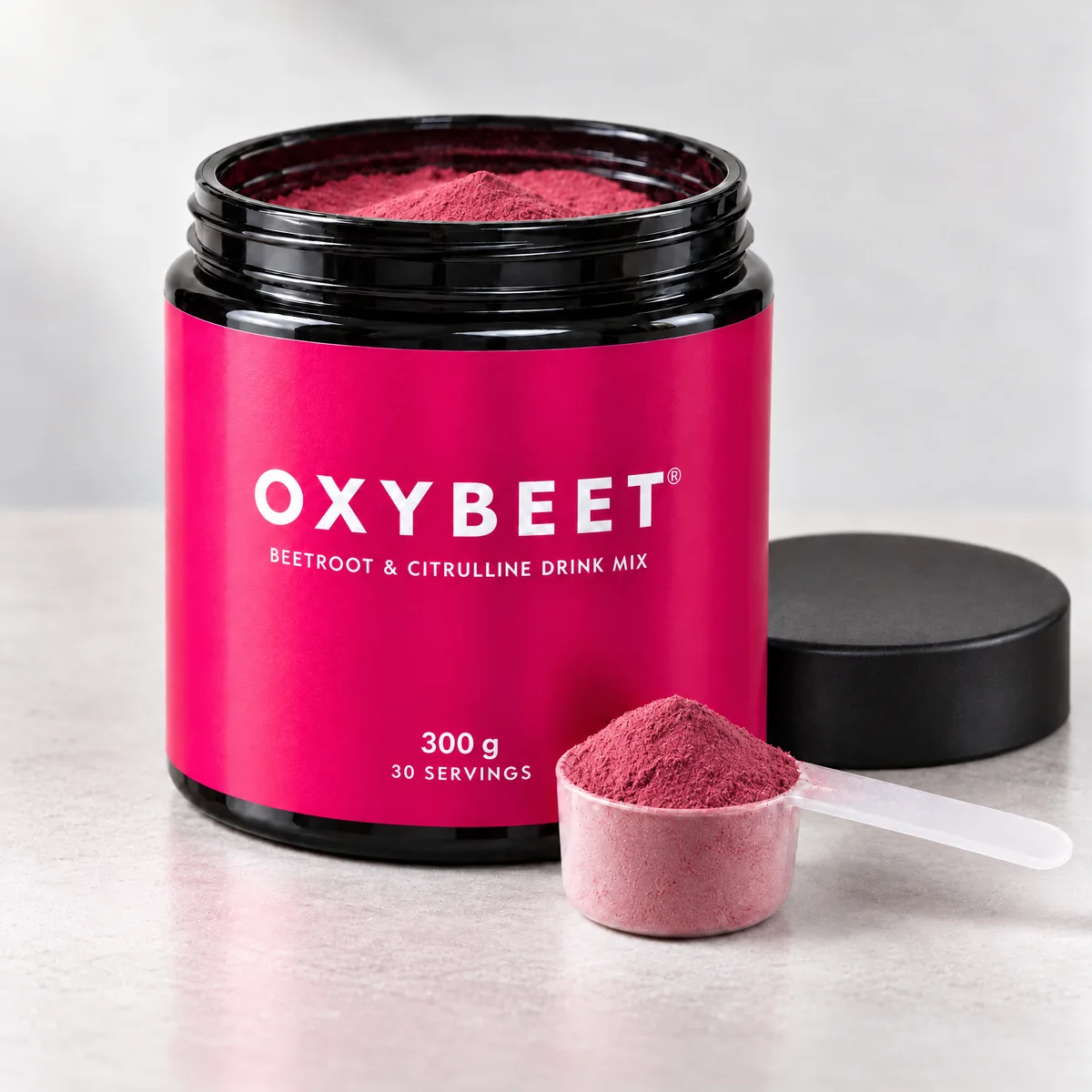
One scoop of OXYBEET® contains 500 mg of vitamin C. That is 625% of the nutrient reference value.20
Vitamin C
44 studiesfunction of the inner lining of blood vessels
A review of 44 randomised studies found that vitamin C improved the function of the inner lining of blood vessels, known as the endothelium. The effect was greater in people at higher risk of cardiovascular disease and increased with the dose.
In people with high blood pressure, vitamin C administered directly into an artery improved blood vessels' ability to widen. When researchers blocked NO production, the effect disappeared.
49 participants · vitamin C administered into an artery
In blood vessel cells, vitamin C increased levels of tetrahydrobiopterin to as much as three times their original level. Without this substance, the enzyme that produces NO cannot work properly.
You can find each study on PubMed or the publisher's website.
The Nobel Assembly at the Karolinska Institute. The Nobel Prize in Physiology or Medicine 1998: press release, 12 October 1998. Source
Celermajer DS, Sorensen KE, Spiegelhalter DJ et al. Aging is associated with endothelial dysfunction in healthy men years before the age-related decline in women. J Am Coll Cardiol. 1994;24(2):471-6. PubMed 8034885DOI
Taddei S, Virdis A, Ghiadoni L et al. Age-related reduction of NO availability and oxidative stress in humans. Hypertension. 2001;38(2):274-9. PubMed 11509489DOI
Webb AJ, Patel N, Loukogeorgakis S et al. Acute blood pressure lowering, vasoprotective, and antiplatelet properties of dietary nitrate via bioconversion to nitrite. Hypertension. 2008;51(3):784-90. PubMed 18250365DOI
Kapil V, Khambata RS, Robertson A, Caulfield MJ, Ahluwalia A. Dietary nitrate provides sustained blood pressure lowering in hypertensive patients: a randomized, phase 2, double-blind, placebo-controlled study. Hypertension. 2015;65(2):320-7. PubMed 25421976DOI
Siervo M, Lara J, Ogbonmwan I, Mathers JC. Inorganic nitrate and beetroot juice supplementation reduces blood pressure in adults: a systematic review and meta-analysis. J Nutr. 2013;143(6):818-26. PubMed 23596162DOI
Kelly J, Fulford J, Vanhatalo A et al. Effects of short-term dietary nitrate supplementation on blood pressure, O2 uptake kinetics, and muscle and cognitive function in older adults. Am J Physiol Regul Integr Comp Physiol. 2013;304(2):R73-83. PubMed 23174856DOI
Bailey SJ, Winyard P, Vanhatalo A et al. Dietary nitrate supplementation reduces the O2 cost of low-intensity exercise and enhances tolerance to high-intensity exercise in humans. J Appl Physiol. 2009;107(4):1144-55. PubMed 19661447DOI
Bondonno CP, Dalgaard F, Blekkenhorst LC et al. Vegetable nitrate intake, blood pressure and incident cardiovascular disease: Danish Diet, Cancer, and Health Study. Eur J Epidemiol. 2021;36(8):813-25. PubMed 33884541DOI
Maughan RJ, Burke LM, Dvorak J et al. IOC consensus statement: dietary supplements and the high-performance athlete. Br J Sports Med. 2018;52(7):439-55. PubMed 29540367DOI
Schwedhelm E, Maas R, Freese R et al. Pharmacokinetic and pharmacodynamic properties of oral L-citrulline and L-arginine: impact on nitric oxide metabolism. Br J Clin Pharmacol. 2008;65(1):51-9. PubMed 17662090DOI
Bailey SJ, Blackwell JR, Lord T et al. l-Citrulline supplementation improves O2 uptake kinetics and high-intensity exercise performance in humans. J Appl Physiol. 2015;119(4):385-95. PubMed 26023227DOI
Moinard C, Nicolis I, Neveux N et al. Dose-ranging effects of citrulline administration on plasma amino acids and hormonal patterns in healthy subjects: the Citrudose pharmacokinetic study. Br J Nutr. 2008;99(4):855-62. PubMed 17953788DOI
Rhim HC, Kim SJ, Park J, Jang KM. Effect of citrulline on post-exercise rating of perceived exertion, muscle soreness, and blood lactate levels: a systematic review and meta-analysis. J Sport Health Sci. 2020;9(6):553-61. PubMed 33308806DOI
Le Roux-Mallouf T, Pelen F, Vallejo A et al. Effect of chronic nitrate and citrulline supplementation on vascular function and exercise performance in older individuals. Aging (Albany NY). 2019;11(10):3315-32. PubMed 31141497DOI
Ashor AW, Lara J, Mathers JC, Siervo M. Effect of vitamin C on endothelial function in health and disease: a systematic review and meta-analysis of randomised controlled trials. Atherosclerosis. 2014;235(1):9-20. PubMed 24792921DOI
Taddei S, Virdis A, Ghiadoni L, Magagna A, Salvetti A. Vitamin C improves endothelium-dependent vasodilation by restoring nitric oxide activity in essential hypertension. Circulation. 1998;97(22):2222-9. PubMed 9631871DOI
Heller R, Unbehaun A, Schellenberg B et al. L-ascorbic acid potentiates endothelial nitric oxide synthesis via a chemical stabilization of tetrahydrobiopterin. J Biol Chem. 2001;276(1):40-7. PubMed 11022034DOI
Regulation (EU) No 1169/2011 on the provision of food information to consumers, Annex XIII (nutrient reference values). Source
Try it for 30 days, risk-free
Drink OXYBEET® for 30 days in a row. If you don't notice an effect after the last scoop, write to us and we'll refund your money.